Introducing Frame War
Submit your best edit, make it into the Top 3, and compete for the monthly Frame War reward. The winner receives cash plus exposure across EarnEdits community channels.

PRODUCT CATEGORIES
Submit your best edit, make it into the Top 3, and compete for the monthly Frame War reward. The winner receives cash plus exposure across EarnEdits community channels.
 Back
Back

 Jul 20, 2026
 Muhammad Sikandar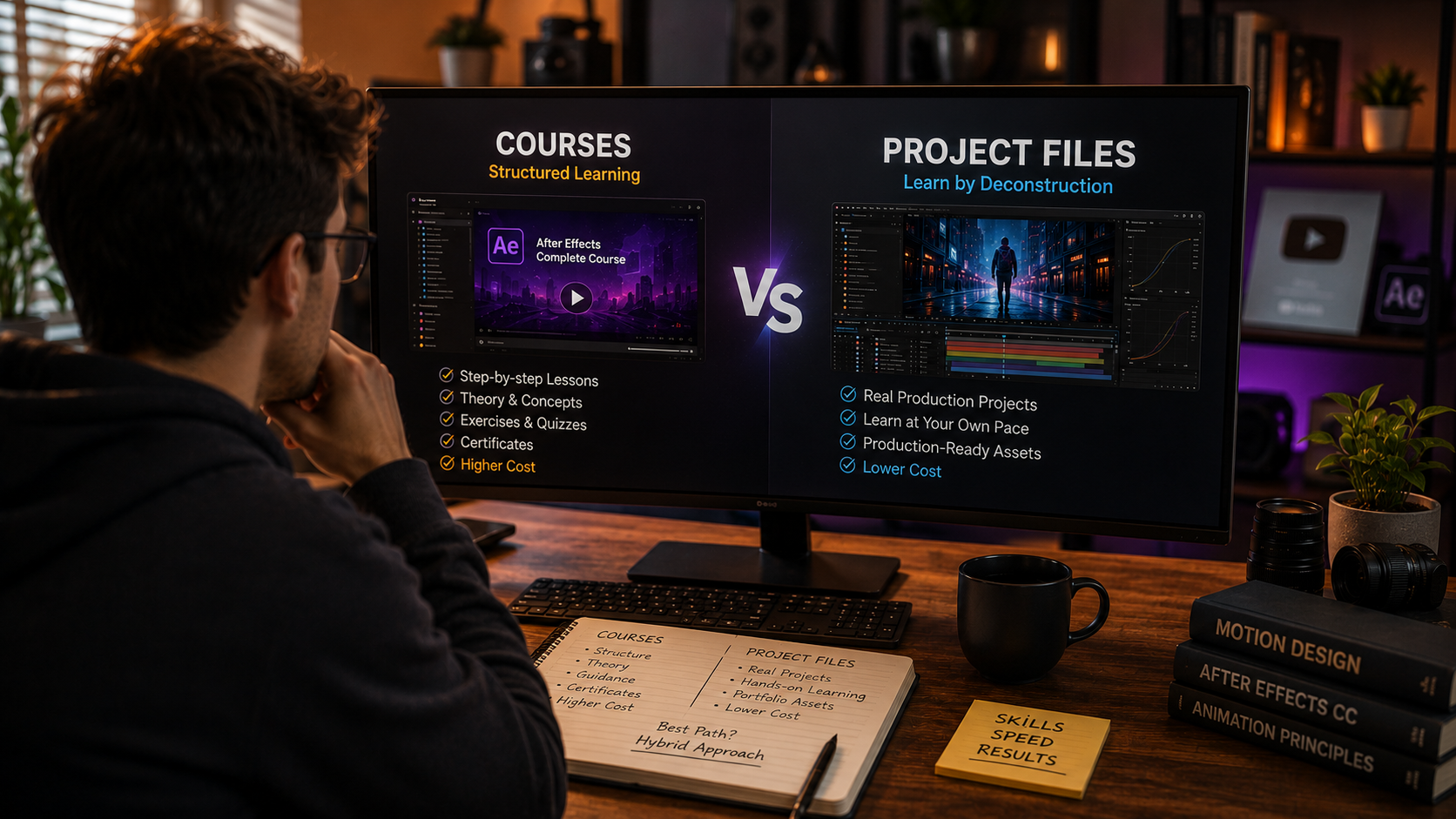
After Effects courses teach through scheduled lessons and theory, while project files teach through deconstruction of real professional timelines. The methods differ on five dimensions: what the learner finishes with, pacing control, theory depth, cost structure, and skill retention. Courses win on structured accountability and theory foundations. Project files win on production output, pace control, and cost per skill gained. The strongest path for most working editors combines a short fundamentals phase with the file-study method. The comparison below maps exactly where each approach earns its place.
The table below maps both learning methods across the seven dimensions that decide the choice.
| Dimension | Structured courses | Project-file method |
| What you finish with | Certificates and exercises | Skill plus production-ready files |
| Pacing | Fixed by the curriculum | Set by the learner, one file per week |
| Theory depth | Strong, sequenced fundamentals | Learned through observed decisions |
| Cost structure | Hundreds to over a thousand dollars upfront | Subscription or per-file pricing |
| Accountability | External: schedules, deadlines, cohorts | Internal: the weekly file rhythm |
| Production output during learning | None | Every studied file doubles as an asset |
| Skill retention driver | Assignments and review | Rebuild-from-memory practice |
The output row carries the economics of the whole decision. A course graduate finishes with knowledge and practice exercises. A file-method learner finishes with the same techniques plus a folder of customizable production files earning money on client work from month two.
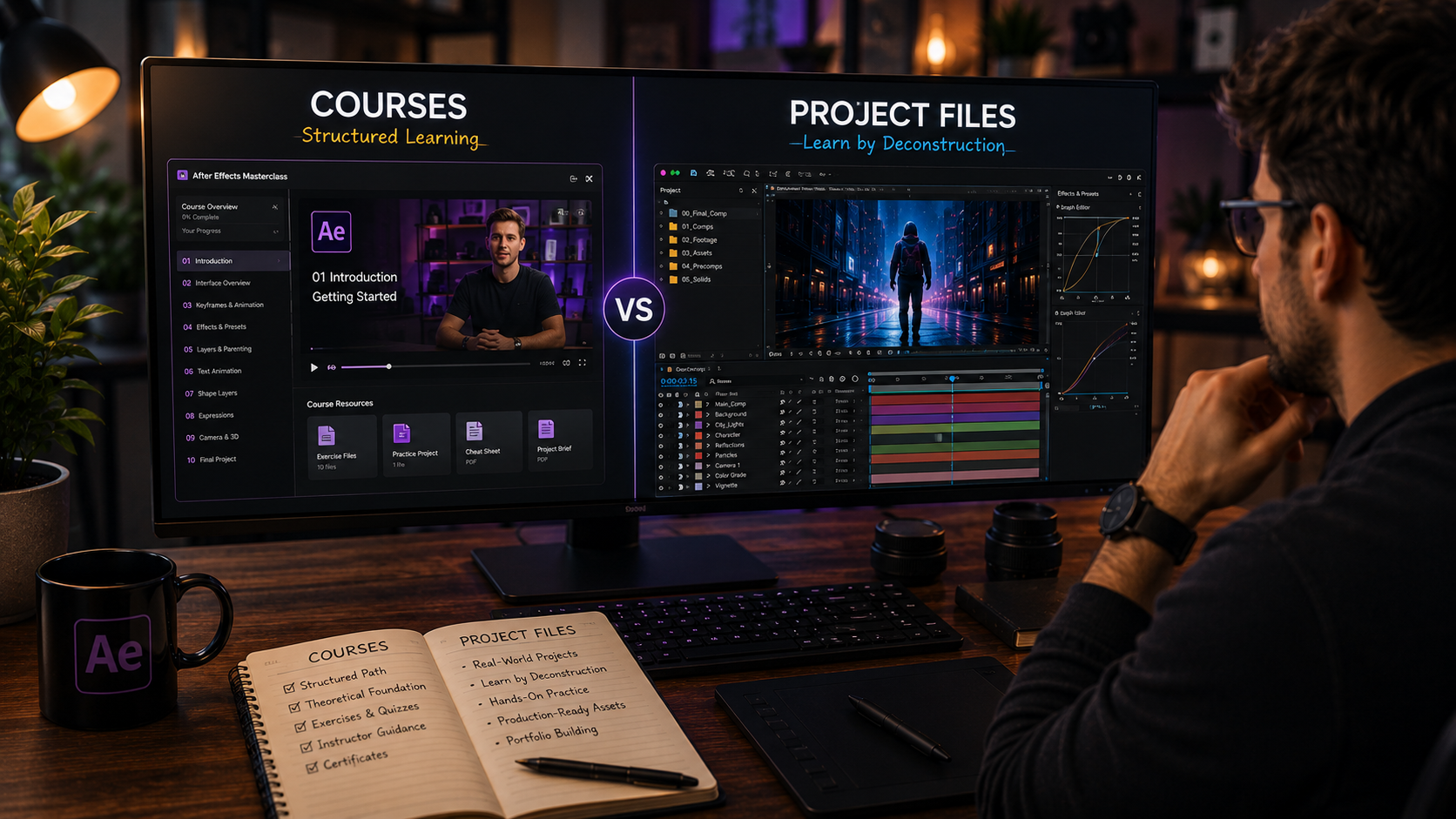
A structured course sequences After Effects into scheduled lessons: interface, keyframes, effects, expressions, projects, in curriculum order. The instructor decides the path, the pace, and the examples. Quality courses add assignments, feedback, and community, which is where the real course value concentrates.
The project-file method studies finished professional work directly. The learner opens a real .aep, walks the timeline, isolates one technique, and rebuilds it from memory in a fresh composition. The 4-stage loop replaces the curriculum, and the studied files replace the example library. The complete method lives in our guide to learning After Effects with real project files.
Course completion produces understanding, and file study produces understanding plus inventory. Every deconstructed file remains in the learner’s library as a customizable production asset. The same file studied in week three ships a client deliverable in month two. Course exercises serve the lesson and then serve nothing.
The distinction compounds financially. The file-method learner recovers the learning cost through the first client project built on a studied file. The course learner recovers cost only after separately sourcing production assets.
Courses fix the pace, and the file method hands the pace to the learner. Fixed pacing helps learners who stall without external structure, and the schedule is the product those learners are paying for. Fixed pacing punishes learners who move faster or slower than the cohort. The fast learner waits, and the slow learner falls behind a schedule that keeps moving.
The file method runs on one rhythm: one file per week, fully deconstructed. Faster learners take denser files. Slower learners take simpler files. The rhythm holds while the difficulty adjusts, which no fixed curriculum offers. The full timeline math across methods sits in our guide on how long learning After Effects takes.
Courses teach the principle first and the application second, and files teach the application first with the principle visible inside it. A course explains easing theory across a lesson. A file shows forty shaped easing curves inside one finished edit, each one a decision with a visible result.
Theory-first suits learners who want the conceptual map before touching the timeline.
Decision-first suits learners who extract principles from working examples. Neither is wrong. The failure mode belongs to a third group: learners who consume theory endlessly and build nothing. The pattern and its exit are covered in our guide on why project files beat generic tutorials.
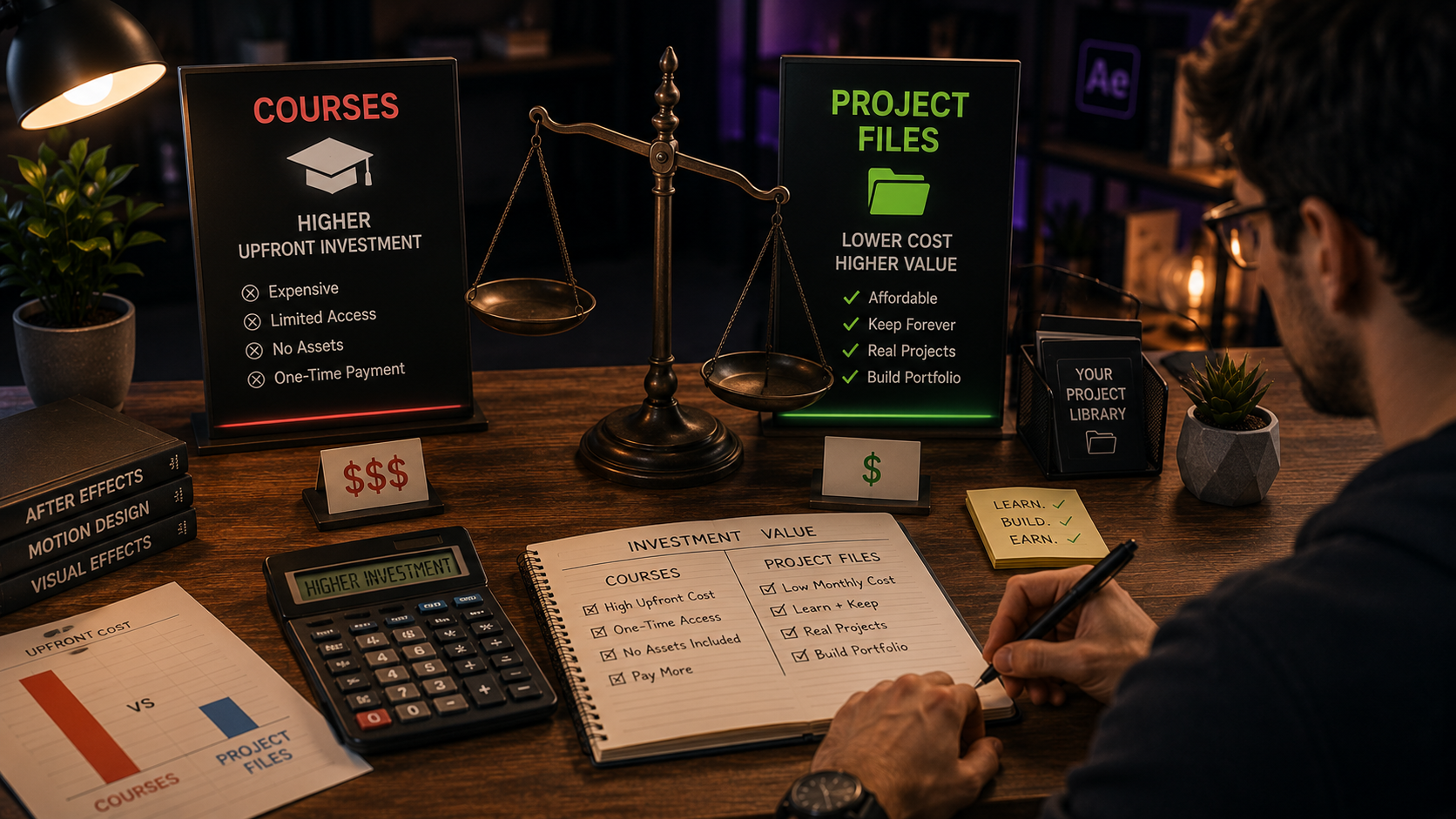
Structured After Effects courses typically cost hundreds to over a thousand dollars upfront, and the file method costs a subscription or single-file prices. The raw numbers favor files heavily, and the honest comparison adds what each price buys.
The course price buys sequencing, instructor access, feedback, and community. Learners who use those components extract real value. Learners who watch the videos and skip the community pay the full price for the fraction a file subscription delivers cheaper. The file price buys the open timelines plus the paired build tutorials, with the accountability supplied by the learner.
Courses earn the choice in three situations, and the file method does not replace them there.
The pattern across all three: the course earns its price through the human and structural layer, never through the video content alone.
The strongest real-world path runs a short fundamentals phase into the file method, and the two stop competing. Two to three weeks of free interface fundamentals covers navigation. The file rhythm takes over from there: one open file per week, each paired with its build tutorial, each rebuilt from memory.
The pairing is the EarnEdits structure by design. Every file in the library ships with its paired lesson in the After Effects tutorials built on real project files. The learner gets the course-style explanation AND the open timeline in one subscription, at a fraction of structured-course pricing.
Courses are worth the price when the learner uses the feedback, community, and schedule, and not when the videos are the only component consumed. The video content alone is the replaceable part.
Project files replace the course for learners who hold a weekly rhythm on their own. The file method covers the full technique path. The course adds external structure for learners who want it supplied.
Clients hire on portfolio and delivery, and certificates rarely enter the decision. A folder of finished, customized edits built from studied files outweighs any certificate in client conversations.
The file method costs less upfront and pays back through production inventory. Course pricing runs hundreds to over a thousand dollars with no production assets included. File-method costs return through the first client deliverable.
Free fundamentals first, then the file method. Two to three weeks of interface basics through free resources, then one organized project file per week with full deconstruction and rebuild practice.

Explore more guides on After Effects project files and viral editing workflows.
Production-ready edits that teach you how they were built.